Car Using More Fuel Than Usual? How to Find the Cause
Does your car seem to burn more fuel than usual, despite driving the same distance? If you are making more visits to the petrol station, your car may be struggling to maintain its fuel efficiency. The fortunate part is that it does not always signify a severe problem with the engine itself.
In this guide, you will see how to check for indications that your car needs more than usual fuel usage, the most probable reasons for the problem, how to know if there is a problem, and when to call a professional. In addition, you will learn some easy tips on saving fuel without costly repairs.
Know If Your Car Is Using More Fuel Than Usual
The best way to detect mechanical problems is to first ensure that your car is not using up more petrol than it is used to consuming.
If your fuel gauge drops rapidly, it doesn’t always mean there is a problem with your car. Fuel consumption can also be influenced by changes to the amount of traffic, the speed of vehicles, the use of air conditioning, distance traveled, and weather conditions.
These are some of the typical symptoms to watch for:
- Regular petrol top-ups: It means that you are making more trips to petrol stations, although no more miles per day!
- Moved fuel gauge is visible in the previous step is not considerate: The fuel level seems suddenly and quickly to have fallen.
- Fewer kilometres for 1 litre of petrol: You will get fewer kilometres for 1 litre of petrol from your car.
- Higher gas costs: Monthly gas consumption goes up, but your driving patterns haven’t changed.
- Improved performance: If the engine requires an adjustment, the car will feel less responsive, hard to accelerate, or have a rough idle.
- Demonstrates unusual exhaust smoke, or petrol smell – Fuel system or engine issues require checking.
Calculate Your Actual Fuel Consumption
The most convenient first step is to find out the amount of fuel your vehicle consumes in a specified distance.
For vehicles measured in litres per 100 kilometres (L/100 km), use this formula:
Fuel consumption = (Litres used ÷ Kilometres travelled) × 100
To accurately measure consumption:
- Top to the normal automatic pump shutoff.
- Re-initialize the trip meter.
- Drive in the same manner as you do normally and do not make any attempts to change how you drive.
- Fill the tank with water again, but do the same.
- Note down the litres used and distance driven.
- Repeat several times during fill-ups and compare.
Visit: UAE Fuel Cost Calculator

Reasons Your Car Is Using More Fuel Than Usual
The following are some of the most common explanations for increased fuel consumption. Do the simple checks and don’t presume what’s gone wrong is a costly component.
1. Low Tyre Pressure
Low tyre pressure raises rolling resistance, which requires the engine to expend more of its energy to propel the vehicle over the stiffer ride. Pressure that is not correct can also negatively impact handling, tyre wear, as well as braking.
You don’t need to see a lot of flatness to have underinflated tyres. It’s better to take regular pressure checks than trying to get a guess from how the tyres appear.
Signs to look for:
- A warning light for low tyre pressure comes on in the instrument panel.
- Tyre leaks air over and over.
- Different appearance when directing the steering.
- Meanwhile, even tyre wear is accompanied by deteriorating fuel consumption.
The National Highway Traffic Safety Administration’s tyre safety guidance explains how correct inflation supports safety, tyre life, and fuel efficiency.
2. Heavy Traffic and Aggressive Driving
How you drive does have an impact on the amount of fuel used! The obvious answer is going to jump out at you; driving without a hard start or stop, speeding up on a stoplight instead of accelerating rapidly, does reduce fuel consumption.
If you push your car or bike only hard, its engine needs to work harder. If you brake right after, a lot of the energy that you expended to accelerate the car is wasted.
How to cut down on gas consumption:
- Accelerate smoothly.
- Plan ahead; predict traffic movements.
- Drive a safe following distance.
- Avoid unnecessary speeding.
- A useful path in which one does not need to keep stopping if possible.

3. Frequent Short Trips and Cold Starts
Where you drive your car, your car can consume more fuel per kilometre if you drive short distances predominantly.
During warm-up, a cold engine might require extra fuel. Engine oil, too, gets thicker in freezing temperatures; plus, engine and emissions control systems have to get back into normal operating condition.
4. Excessive Idling and Air-Conditioning Use
Fuel can be consumed in the standstill car. A car idling for long periods of time, in formed traffic and in parking lots, consumes fuel but provides no mileage.
The air conditioner in the cooling system is also a consumer of energy, and this energy consumption could result in fuel consumption. The effect will be dependent on the type of vehicle, ambient temperature outside of the vehicle, as well as on the cooling requirements and driving conditions.
How to reduce unnecessary consumption:
- Don’t idle the engine unnecessarily for a long period of time.
- Operate the vehicle (where available) within its capability (including stop-start).
- Air conditioning sensibly and to ensure a safe cabin environment.
- Keep the cooling system and cabin air filter according to the manufacturer’s recommendations.
Read more: Fuel Consumption While Idling
5. Incorrect Wheel Alignment or Unsuitable Tyres
Wheel alignment relates to the way in which tyres connect with the road. Thicker out-of-truing can cause tyre resistance and different wear patterns.
Tyres that are not the correct dimensions and/or specification can also have an impact on rolling resistance and, in certain situations, the accuracy of distances.
People may have symptoms such as:
- The car pulls to one side.
- The steering wheel is off-center on the wheel while driving straight.
- Tyres are unevenly worn.
- After colliding with a pothole or kerb, steering behaviour changes.
Read more: Does Low Tyre Pressure Increase Fuel Consumption?

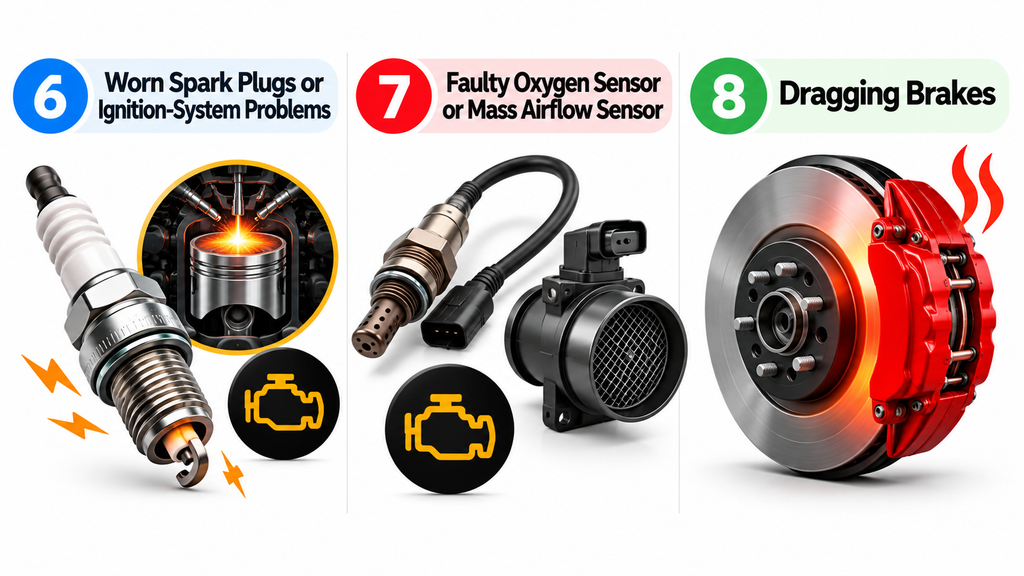
6. Worn Spark Plugs or Ignition-System Problems
For a petrol/air engine, it is the spark plug that ignites the air/fuel mixture. Old, dirty, or faulty spark plugs may not make good contacts, or may fail to produce a spark when needed.
This may lead to misfire, smoking, poor performance, more fuel use, and a host of other driving issues. Symptoms are similar if there are issues with the ignition coil or other problems with the ignition system.
Symptoms of the possible ignition problem:
- The power is intermittent, or the engine vibrates.
- Acceleration becomes weaker.
- The engine misfires.
- Starting becomes difficult.
- Check Engine warning light comes on.
7. A Faulty Oxygen Sensor or Mass Airflow Sensor
Key modern petrol engines work with sensors to assist the computer in controlling the fuel delivery.
The oxygen sensor will measure the amount of oxygen in the exhaust, which will feed into the engine management system to adjust the air/fuel ratio. In combination with the installation of the mass airflow sensor, the computer receives information about the amount of air entering into the engine and calculates the quantity of fuel.
Possible symptoms include:
- Unregulated fuel usage.
- Engine idles on the move.
- Acceleration becomes weaker.
- Check engine light comes on.
- Diagnostic trouble codes are remembered.
8. Dragging Brakes
The brakes have friction to slow the vehicle. Unwanted friction or a parking brake that fails to release completely during driving results from a brake caliper sticking in place.
The engine then needs to overcome additional resistance, potentially increasing fuel consumption.
Warning signs include:
- The car feels unusually sluggish.
- The vehicle pulls to one side.
- You notice a burning smell near a wheel.
- One wheel becomes unusually hot.
- Fuel economy drops alongside abnormal braking behaviour.
9. A Faulty Thermostat or Engine Temperature Problem
Temperature Range: The desired temperature operating range. The thermostat helps to keep the coolant operating the engine at the proper temperature while it is in use.
If the thermostat is stuck open, the engine may need to operate for a much longer time to maintain the desired operating temperature or it may not even reach the desired operating temperature. This can result in long periods of fuel enrichment during warm-up and can increase fuel consumption for some models.
Possible signs include:
- The temperature sensor is very slow to return to normal.
- The engine is cooler running than normal.
- Fuel consumption increases, particularly on short journeys.
- It displays a diagnostic code that is related to temperature.
10. Overdue Maintenance, Incorrect Oil, or Other Engine Faults
In the absence of a care program, issues can arise, or they can go unnoticed. If engine oil specifications are not used, the result can be an incorrectly operating engine or decreased efficiency of the machine.
Air filter holes that are too small can also have an impact on the performance of the engine and how it performs. But changing a dirty air filter isn’t enough to improve fuel efficiency in a modern fuel-injected gasoline car. A low-restriction filter does not necessarily impact engine performance but the engine-management system is used to compensate for some changes in airflow.
What to check:
- When the engine oil was last changed.
- Whether the correct oil specification was used.
- Whether the air filter and spark plugs are due for service.
- Whether warning lights or performance changes have appeared.
- Whether there are unusual smells, smoke, or visible leaks.

Find the Cause of High Fuel Consumption
1: Confirm the Increase
Record fuel consumption for a number of towing operations and compare to previous towing attempts. Account for variations in traffic, trip, weather, and AC usage.
2: Check Tyre Pressure
Compare cold tyres with recommended pressures by the manufacturer. Check for outages, wear, or tear, or frequent air loss.
3: Review Driving Conditions
Additional trips, often short trips, idling, high traffic volumes, and speed may be responsible for increased fuel consumption.
4: Review Maintenance
Inspect the service schedule, engine oil specification, spark plugs, and air filter. Do not replace components unless necessary.
5: Check for Warning Signs
Look for any misfiring, sluggish acceleration, exhaust smoke, engine temperature problems, dashboard lights, or erratic idle. These symptoms can provide clues to potential problems but will not definitely point to the cause.
6: Get a Professional Diagnosis
When fuel consumption is high, have a qualified mechanic inspect the ignition parts, sensors, condition of the fuel system, brakes, tyre alignment, and engine temperature as necessary, based on the diagnostic codes.

When Should You Take Your Car to a Mechanic?
If there is a slight change in fuel consumption, it doesn’t always require a workshop visit. But if there is a continuing unexplained rise, it should be considered and, simultaneously, along with other symptoms, it should be evaluated.
Arrange an inspection if:
- The fuel consumption is still high under comparable driving conditions.
- The check engine light remains lit up.
- An engine seizes up, jerks, or produces no power.
- Abnormal braking or steering occurs.
- The engine is always running outside its normal temperature range.
- See pointy fume from the exhaust or a strong smell of the fuel.
Read more: 10 Ways to Cut Your Fuel Bill When Driving
Frequently Asked Questions
Why is My Car Tasting More Fuel?
Low tyre pressure can make driving more demanding and increase your fuel consumption, as can heavy traffic, aggressive driving, short trips, excessive idling, overdue Parts and Service inspection, or a mechanical defect.
Why Is My Car Suddenly Using More Petrol?
A significant surge in fuel consumption could result in slightly under-inflated tyres, dragging brakes, bad engine sensors, ignition problems, or fuel-system issues. Monitor for warning lights and any abnormal symptoms.
Can Low Tyre Pressure Increase Fuel Consumption?
Yes. Tyres with tread deformities increase rolling resistance and make the vehicle’s engine use more fuel. Inspect tyres at cold temperatures.
Final Thoughts
If you find your car is taking more fuel than it needs to, then first ensure the rise in fuel use does not stem from a rise in tyre pressures when you check the tyre pressures of your car; and confirm that your driving habits and maintenance history are causing excessive fuel consumption. Less traveling, more traffic, running the air-conditioner, and sometimes driving at higher speeds could be the cause of high fuel consumption, but if there are noticeable differences over a prolonged period, it may be a fault.