Why a Car May Jerk After Refuelling: Causes to Investigate in the UAE
Ever had petrol in your car that shakes, jerks, or doesn’t start to move smoothly when you put it in? After fueling, if your vehicle is having jerks, this may be related to a leaky EVAP purge valve, jumping fuel, fuel-delivery problem or engine misfire. Knowing what the cause is as early as possible is helpful for UAE drivers to avoid further damage and expensive repairs.
In this guide you will learn some of the potential reasons, signs and what you can do if your car begins to start jerking after getting gas.
Why Does a Car Jerk Immediately After Refuelling?
One possible reason a car jerks after refuelling is that the engine is not getting the right mixture of fuel and air on refuelling, due to poor fuel/air combustion or because the vehicle has a mechanical fault affecting its movement.
If the issue occurs immediately after refueling, it may be a problem with the fuel or the evaporative emission control system (EVAP). Ignition starts, but then stalls; however, there can be various causes for this like ignition fault, fuel-pressure problem, sensors or transmission problems. Use the following hints to make narrowing possibilities down easier:
- Rough idling or jerking shortly after fueling: May be an EVAP purge valve fault.
- Jerking that is associated with loss of power: Fuel delivery issues or a misfiring engine can be factors.
- Failure to restart following fueling: A purge-system failure or another engine-management failure could be causing this.
- Flashing Check Engine Light: Possible misfire and requires immediate attention.

Main Causes of Car Jerking After Refuelling
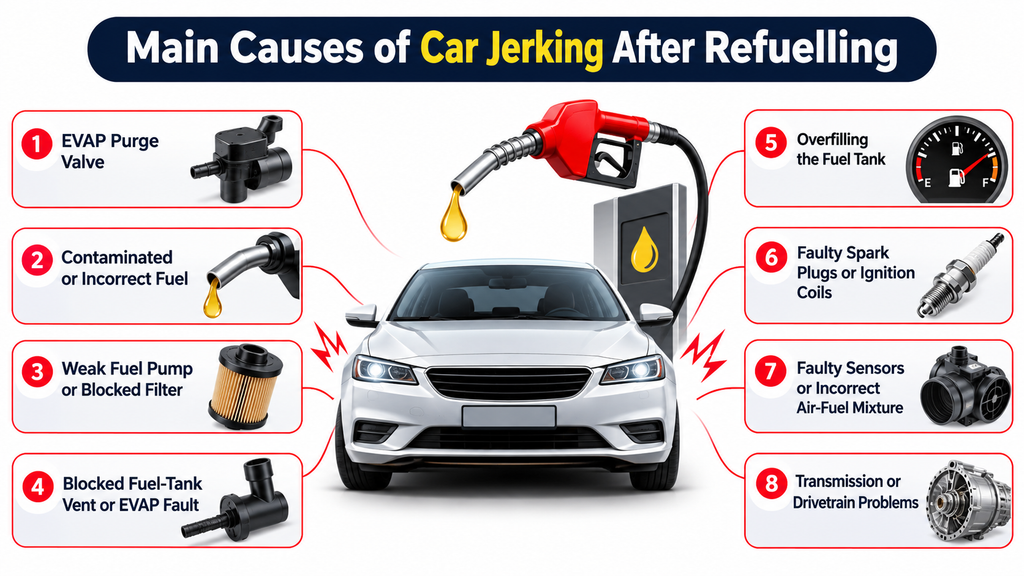
What causes a car to surge immediately after it is filled at the gas station? It could be a faulty EVAP system, fuel system, ignition system, engine sensor, or transmission. There are 8 possible causes that you’ll need to explore.
1. Faulty EVAP Purge Valve
One of the things to consider with rough idling or starting issues in a petrol car right after filling up should be a leaky EVAP purge valve.
Common symptoms:
- Rough idling or shaking while refueling the fuel tank.
- Trouble starting up and/or sudden stalling.
- Starting slowly or stuttering during acceleration.
- Monitor for check engine and EVAP fault codes.
2. Contaminated or Incorrect Fuel
Water, dirt, or incorrect fuel can spoil the combustion and make your engine run irregularly. It is also possible to have serious issues if the wrong type of fuel is used.
Common symptoms:
- Engine sputtering or jerking.
- Less acceleration & power.
- Rough running or misfires.
- Difficulty starting.
3. Weak Fuel Pump or Blocked Fuel Filter
You want a steady flow of fuel at the right pressure to the engine. A poorly performing fuel pump or clogged fuel filter can not supply the proper amount of fuel to the engine, particularly during jerking up and down acceleration.
Common symptoms:
- Jerking when accelerating.
- Reduced power when climbing hills.
- Engine hesitation or stalling.
- Difficulty starting.
4. Blocked Fuel-Tank Vent or EVAP System Fault
The fuel tank must have an adequate venting system for the fuel vapors and pressure. This process can be affected by a blocked vent, broken hose, or worn hose valve.
Common symptoms:
- Clicking off the fuel nozzle while refuelling repeatedly.
- Inability to start up after fueling the tank.
- Smell or odour of gasoline vapours.
- Some rough running in some instances.
5. Overfilling the Fuel Tank
If fuel was pumped and the valve shut off automatically, and fuel was added to the valve afterwards, fuel may flow into the charcoal canister. This can clog the EVAP system and lead to damage to the system.
Possible symptoms:
- Difficulty starting after refuelling.
- Rough idling or engine hesitation.
- Check engine light.
- EVAP-related problems.
6. Faulty Spark Plugs or Ignition Coils
To start the burning of air fuel mixture, spark plugs and to supply electrical energy that is required to create a spark, ignition coils are used. Failure of any component means that the engine can misfire and run poorly.
Common symptoms:
- Idle vibration in engines.
- Jerking during acceleration.
- Reduced engine power.
- Flashing check engine light.
7. Faulty Sensors or Incorrect Air-Fuel Mixture
Air-fuel mixture is controlled by air sensors, such as the mass airflow sensor (MAF), manifold pressure sensor (MAP), and the oxygen sensors. Engine operation may be “too rich” or “too lean” if the sensors return a faulty reading.
Common symptoms:
- Hesitation during acceleration.
- Uneven idling.
- Poor fuel economy.
- Reduced power or check engine light.
8. Transmission or Drivetrain Problems
The car starts jolting during refueling sometimes; this situation is not always related to the fuel system. If one of the vehicle’s drivetrain parts, such as the transmission, clutch, driveshaft, or something else, is malfunctioning, it can produce these symptoms the next time you start the car.
Common symptoms:
- Jerking during gear changes.
- Delayed engagement in Drive or Reverse.
- Shuddering at certain speeds.
- Engine revs rising without normal acceleration.
Read more: How Far Can You Drive After the Fuel Warning Light Comes On?
How Mechanics Diagnose a Car That Jerks After Refuelling
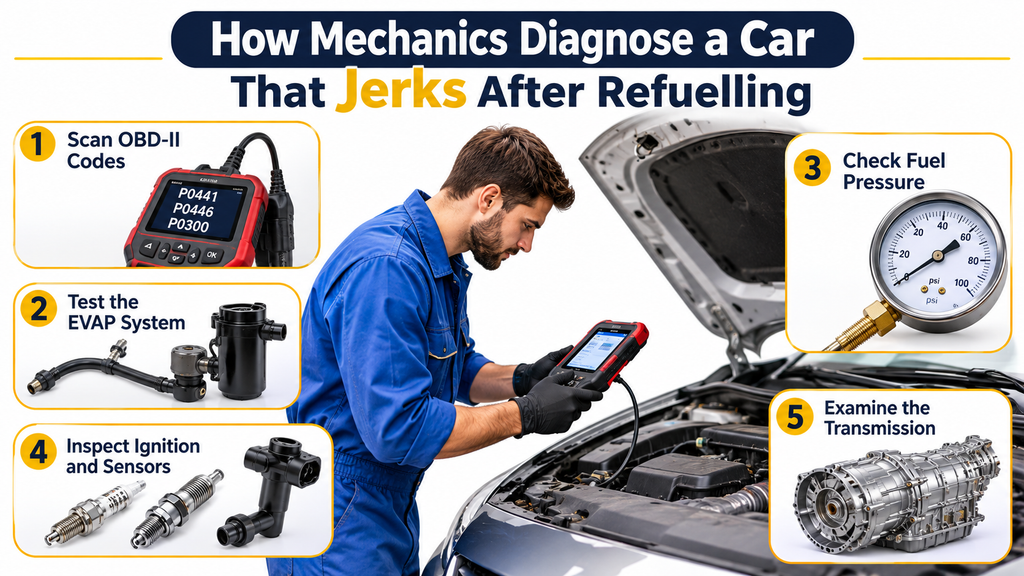
Several vehicle problems can cause similar symptoms, so a proper inspection is essential to identify why your car jerks after refuelling. A qualified mechanic may perform these checks:
1. Scan OBD-II Diagnostic Codes
OBD-II scanner allows you to get the fault codes from your car’s computer. The relevant codes include:
| Code | General meaning |
|---|---|
| P0441 | Incorrect EVAP purge flow |
| P0446 | EVAP vent-control malfunction |
| P0496 | Excessive EVAP purge flow |
| P0300 | Random or multiple-cylinder misfire |
| P0301 | Cylinder 1 misfire |
2. Test the EVAP System
If symptoms occur right after refueling, the mechanic might check for a damaged, leaking, or blocked purge valve, vent valve, charcoal canister, hoses, and connections.
3. Check Fuel Pressure and Delivery
The technician can test fuel pressure to check for fuel pump, electrical, and filter (if fitted) problems. Fuel-quality testing also might be required where contamination is suspected.
4. Inspect Ignition and Engine Sensors
Using diagnostic information and live readings, misfire or incorrect mixture of air and fuel issues such as spark plugs, ignition coils, and engine sensors can be determined.
5. Examine the Transmission and Drivetrain
If the engine starts and runs, but the car lurches or vibrates when shifting gears or at specific speeds, the mechanic might examine the transmission, clutch, driveshaft and other parts of the drivetrain.
Can UAE Heat Cause a Car to Jerk After Refuelling?
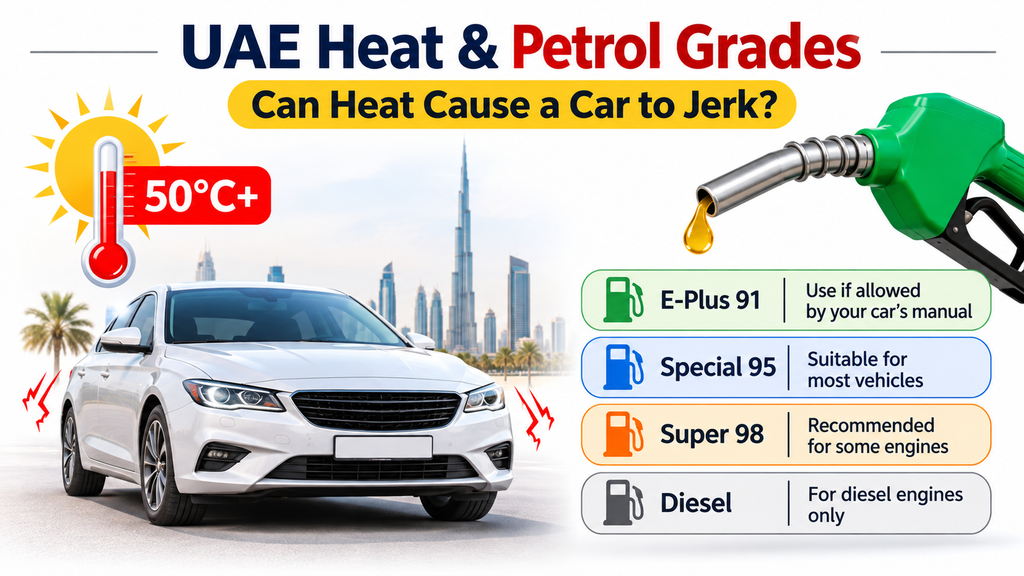
High temperatures are an important consideration for UAE motorists, but heat alone does not prove that a car’s jerking is caused by the fuel system.
Fuel temperature and ambient temperature can influence the amount of vapour generated inside a petrol tank. Modern vehicles use evaporative-emissions components to manage these vapours and prevent unnecessary fuel-vapour release.
Read more: Why Your Car’s Fuel Economy Has Dropped
Which UAE Petrol Grade Should You Use?
UAE petrol grades commonly include E-Plus 91, Special 95 and Super 98. The appropriate choice depends on the manufacturer’s requirements for your specific vehicle.
| Petrol grade | What drivers should know |
|---|---|
| E-Plus 91 | Use only if your vehicle’s manufacturer permits this grade |
| Special 95 | Suitable for vehicles whose specified fuel requirements allow it |
| Super 98 | Required or recommended for some engines, depending on manufacturer guidance |
| Diesel | A different fuel for diesel engines; do not use it in a petrol vehicle |
Read more: Bad Petrol Symptoms
FAQs — Car Jerking After Refuelling
What causes my car to seize up after refuelling?
The leak is often from a faulty EVAP purge valve, something that is contaminated in the petrol, issues in the fuel delivery system, or even some misfiring from the engine.
Is car jerking a symptom of a faulty EVAP purge valve?
Yes. A dirty air filter can make the engine idle rough, stall, or have starting problems when the oil pump is stuck open, which can be caused by either a leak at the mount or a melting filter screen.
Does low-quality petrol cause my car to jerk?
Yes. Fuel impurities, such as water, may prevent combustion, leading to sparking, misfire, hesitation, and engine power loss.
Final Thoughts
If your car starts jerking after refuelling, don’t ignore it. It may be caused by a damaged EVAP valve, poor fuel, fuel delivery malfunction, ignition trouble, or even a rough transmission. Use the recommended petrol grade – never overfill- and get the car rechecked if the problem persists. This can avoid expensive repairs and keep your car running smoothly and safely if you find the cause early.