How Far Can You Drive After the Fuel Warning Light Comes On?
How many miles can you drive while the fuel indicator is illuminated? In some of these vehicles, the extra range could be around 40- 50 km, depending on the conditions of fuel level and driving, as well as the vehicle in question. Traffic congestion and use of air-conditioning and prolonged driving times on the highway may impact travel distance for UAE road users.
In this guide, you’ll learn how to estimate your remaining fuel range, what affects reserve distance, and how to find a suitable petrol station before you run out of fuel.
How Far Can You Drive on Reserve Fuel?
This is not a standard distance for all cars. The recommended driving distance after the fuel low warning is given is typically 40-50 km, although your car may be capable of much greater or less range.
Here are some of the tips that you may want to consider:
- In general, a standard rule for automotive tips is 40-50 km, but it is possible to go beyond that.
- Fuel reserve: When a warning is issued, it displays in the vehicle how much fuel is remaining.
- Driving conditions can affect fuel consumption: Traffic, road gradients, speed, acceleration, air conditioning demands.
- Do not use the distance to empty as a guarantee: Use the range indicator on the dashboard as an approximation, instead.
How Many Kilometres Can You Drive After the Fuel Light Comes On?
The distance travelled is influenced by two factors: how much usable fuel remains and what your car’s consumption is per 100 kilometres.
One of the things that a small, efficient car may have is that it may be able to go further than larger, less efficient SUVs on the same amount of petrol. But the type of vehicle doesn’t specify how much fuel is left at the time of the warning.
The following table illustrates how different reserve amounts and consumption rates affect the calculated range.
| Usable fuel remaining | Consumption | Calculated distance |
|---|---|---|
| 2 litres | 5 L/100 km | 40 km |
| 3 litres | 6 L/100 km | 50 km |
| 4 litres | 8 L/100 km | 50 km |
| 5 litres | 10 L/100 km | 50 km |
| 3 litres | 10 L/100 km | 30 km |
| 4 litres | 12 L/100 km | 33 km |
Before your next journey, check the latest UAE petrol prices to help estimate your refuelling budget.
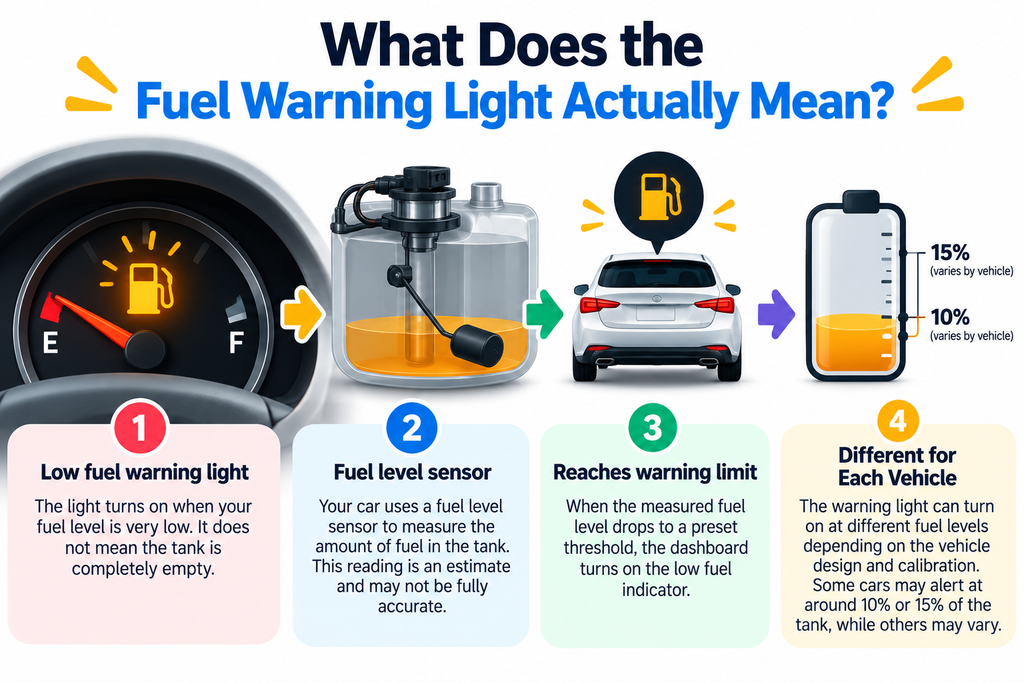
What Does the Fuel Warning Light Actually Mean?
The low fuel warning light indicates an extremely low fuel level (set by the fuel monitoring system) in your vehicle. It does not necessarily mean that the tank is completely empty.
The majority of traditional petrol cars employ a fuel level sensor to gauge the level of fuel in the fuel tank, which is not even accurate. If the measured level gets to the warning threshold, the dashboard will turn on the low fuel indicator.
But this limit is different for each vehicle. No car can be considered as fueling up to 10% or 15% of the tank and then turning on an alert.
How to Calculate Your Fuel Tank Reserve Driving Distance
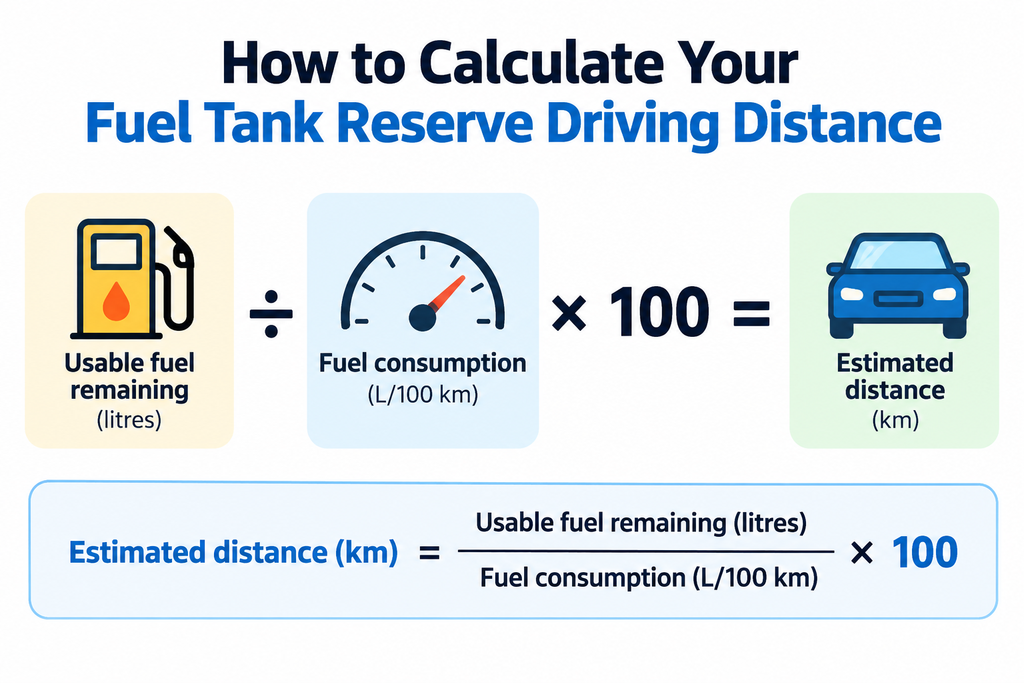
If you have an idea of how much fuel you have left and how much fuel your car consumes on average, you can make an estimate of your range.
Use this formula:
Estimated distance (km) = Usable fuel remaining (litres) ÷ Fuel consumption (L/100 km) × 100
To estimate how much a journey may cost, use our guide to calculating fuel cost for a trip in the UAE.
What Affects Your Remaining Fuel Range?
The distance travelled by the car after the warning from fuel will depend on several factors. Being aware of these factors will enable you to make a more sensible plan for the next refuelling point.
1. Vehicle fuel efficiency
Fuel efficiency quantifies “how far your car gets per amount of fuel.
A car averaging 5 L/100 km generally uses less fuel per kilometre than one averaging 10 L/100 km under comparable conditions. Therefore, the more efficient vehicle can theoretically travel farther on the same amount of usable fuel.
2. Vehicle type and engine size
In most cases, smaller vehicles will drive for less distance in a given amount of time than the larger SUVs, using less gasoline in the process. Reserve distance is not necessarily determined by engine size, however.
The outcome also depends on the design of the tanks, weight of the vehicle, engine performance, fuel consumption, and how fast the level in the tank drops.
3. Traffic congestion in the UAE
Frequent idling, stopping, and starting reduce fuel efficiency in the event of heavy traffic.
In situations when it displays low fuel in areas that are busy in Dubai, Abu Dhabi, or Sharjah, determine a more appropriate nearby station – and not from the distance estimate that was determined during normal highway driving.
4. Air-conditioning and hot weather
Using an air-conditioner will add load to the engine, increasing fuel usage. The effect depends on the vehicle, the outside temperature, the cooling required, and the outside driving conditions.
This is especially important in the UAE during summer when the temperatures can be very hot.
5. Driving speed and acceleration
Unnecessarily high speeds and rapid acceleration can lead to higher consumption. Smooth driving can result in some reduction of waste, but smooth driving doesn’t ensure a minimum of reserve distance.
Unless the warning is to fly, keep to a safe speed, don’t accelerate too quickly, and obey traffic laws. Don’t drive too slowly or make unnecessary risky manoeuvres to save fuel.
6. Hills, road conditions, and vehicle load
Driving uphill costs more since more energy is needed for this action; heavy loads will consume more. Stops, road construction, congestion, and other factors can also have an impact on average fuel economy.
7. Vehicle condition and tyre pressure
Tyre underinflation can lead to reduced fuel efficiency due to mistyping, mechanical issues, or lack of proper maintenance. When a vehicle is using more fuel than it should be, don’t take that for granted; dig into why it may be.
For more practical advice, read our guide to 10 ways to cut your fuel bill when driving in the UAE.

What Should You Do When the Fuel Warning Light Comes On in the UAE?
If the warning light comes on, the first concern is to get to an appropriate site for refueling safely.
Step 1: Find a suitable petrol station
Try and use the navigation app to zoom to a station where you get to your route safely.
“Use our guide to find a petrol station near you in the UAE to check nearby locations and choose a suitable station along your route.”
Step 2: Avoid unnecessary detours
Select a sensible location on your route if possible. Don’t mistake “some range” on the dashboard as a signal to keep going towards a far target.
Step 3: Drive smoothly and safely
Do not under accelerate and do not idle the car engine. Drive behind and obey speed limits; no unnecessary manoeuvres to save fuel.
Step 4: Take extra care on highways
This is not the time to take a guess on when the next station will be reached if the warning happens on a lengthy road trip to the UAE.
Step 5: Arrange assistance if necessary
Seek roadside assistance if you notice that a vehicle’s fuel level is likely to drop to a point where it would not reach a suitable fuel stop/drop-off.

Is It Bad to Drive With the Fuel Warning Light On?
Passing a warning doesn’t mean that your own vehicle would be damaged. But frequent, short trips in a vehicle with little or no gas are not advised.
Potential problems include:
- Unplanned engine failure: you can be stranded in an unsafe place because of running out of fuel.
- Issues with fuel delivery: If the fuel tank is empty or low, then fuel-related problems might result in a problem from the fuel system for some models.
- Damage to the emissions system: If fuel ran to a low level, some manufacturers say the engine may misfire, leading to a higher possibility of damage to the catalytic converter.
- Less flexibility: If you have limited fuel supplies or you find yourself in an awkward spot where you need to stop to get gas, or the road you take changes, you may not know how to get gas.
Planning your next fill-up? See how much it costs to fill up a car in the UAE using different tank capacities and fuel grades.

What Happens If Your Car Runs Out of Fuel Completely?
If your car’s fuel gauge is on “EMPTY” and the engine has died, you always want to keep safety in mind first.
- Move the car, if possible, to a safe place, but not into further danger.
- Turn on your flashers when necessary.
- Take local roadside emergency action and call for help.
- Never walk on or across the road of a highway to fill up with fuel.
- For fuel and start-up, refer to the owner’s manual.
Frequently Asked Questions
How far can you drive after the fuel warning light comes on?
There are numerous guides online that give around 40–50 km, but these figures depend on the car in question, the distance to the gas station, how much fuel is left, and fuel economy. Aim to have it replaced as soon as possible rather than relying on a general estimate.
What is the amount of fuel left when the fuel light turns on?
There is no allocated sum. The warning level will vary depending on the design and calibration of the fuel-tank system. See/installation instructions from the owner.
Can I drive 50 km after the fuel light comes on?
It may, but it does not necessarily, be so. Don’t equate distance to the nearest station with the amount of fuel left in your tank. If you can, search for a more appropriate alternative.
Do all cars have enough fuel to last the same amount of time?
No, various vehicles set different minimum fuel levels for their low fuel warning. The distance after the warning also depends on the fuel consumption and the driving conditions.
Final Thoughts
The distance that you can go beyond the turning on of this fuel light will depend on the amount of fuel that is left in the tank, fuel economy, and driving conditions. This is a general estimate and does not mean that a car will necessarily reach a speed of approximately 40-50 km. Refuel at every opportunity, particularly before long trips in the UAE.