Fuel injector problems: 8 Warning Signs of a Faulty Fuel Injector
Does your car shiver at idle, run poorly, not start up well or need more gas? They might be the indicators that your body is not getting the proper amount of fuel, due to fuel injector issues.
The fuel injector is used to meter a precise quantity of fuel into the engine. When it becomes fouled, leaks, has an electrical or mechanical malfunction, etc., your vehicle may under-perform, leak, and have starting issues, or signal increased emissions.
In the following tutorial you will discover eight warning signs that a fuel injector is bad or failing, causes, and how to diagnose these and when you’ll need to clean or replace the fuel injector.
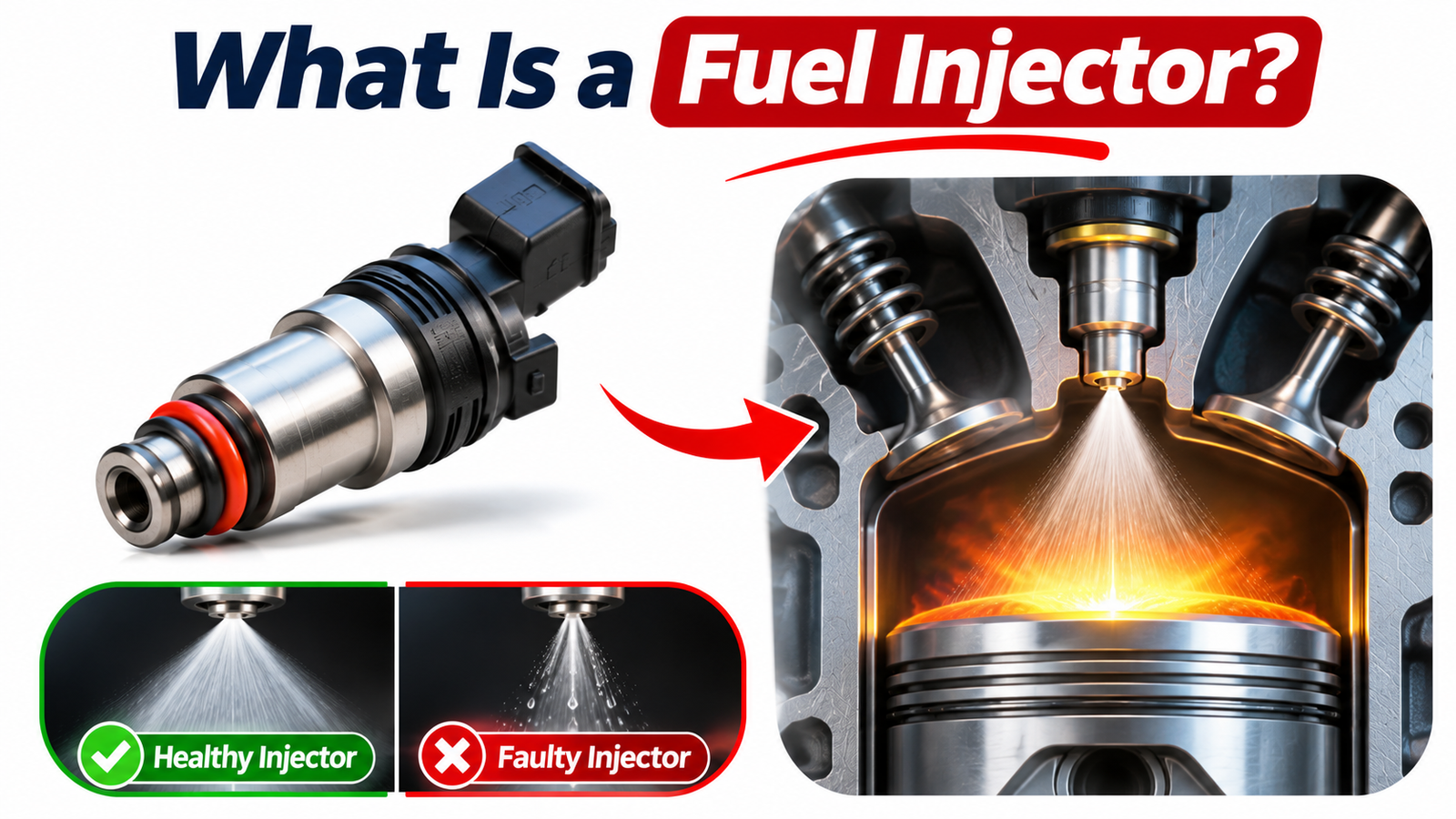
What Is a Fuel Injector?
A fuel injector is a minute valve that precisely delivers fuel into an engine at the proper amount of time and volume. The fuel has to be fed into the intake port or into the combustion chamber, the latter depending on the type of engine, by means of petrol injectors. The purpose of a diesel injector is to maintain a very high pressure for fuel injected into the combustion chamber.
A properly-functioning injector promotes smooth engine operation and efficient combustion. The injector can clog, become a source of fuel leakage or become stuck or be electrically faulty, and thus, can cause engine issues.
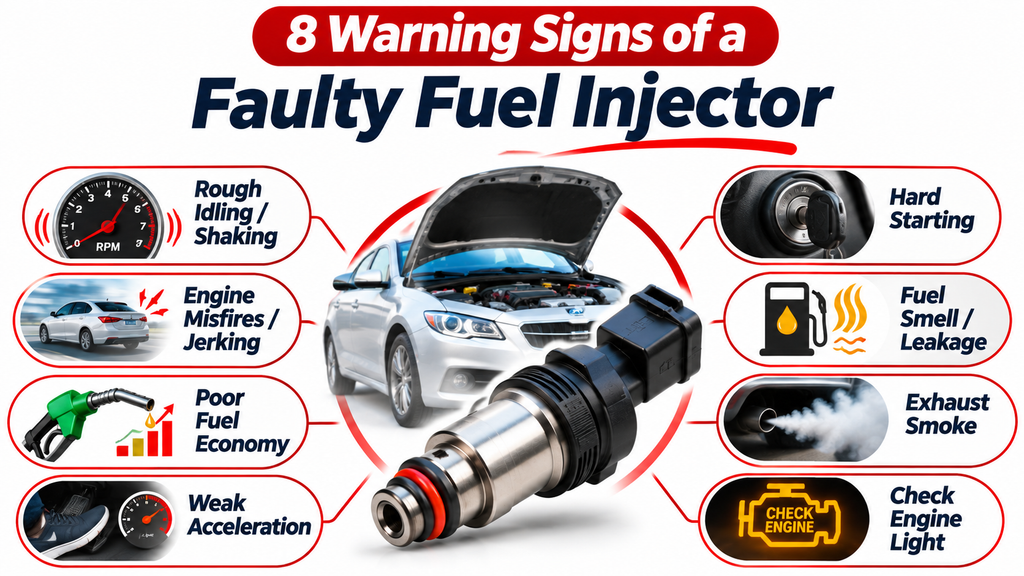
8 Warning Signs of a Faulty Fuel Injector
1. Rough Engine Idling or Shaking
One common symptom of a faulty fuel injector is an engine that vibrates, shakes, or runs unevenly when the car is stationary.
This may occur if there is too much or not enough fuel injected for the type of combustion in one or more cylinders.
Other signs include:
- Unstable engine RPMs.
- Shaking at traffic lights.
- An engine that feels close to stalling.
- Uneven engine sounds.
2. Engine Misfires or Jerking While Driving
Mismfires in an engine are those in which combustion within a cylinder is incomplete. If the injector leaks, is there a limitation on how much fuel can be delivered, or are there electrical issues, there may be an incorrect fuel flow into the supply cylinder.
Some jerkiness when accelerating, stumbling or a sudden loss of smoothness may occur.
Misfires may be caused by a misfiring spark plug, ignition coil, low fuel pressure or poor compression.
3. Poor Fuel Economy
If your vehicle begins to ignite more fuel than normal without good reason, it may be the leaking or broken injector that’s to blame.
Too rich a mixture can be the result of a leaky injector or one that puts in too much fuel. A restriction in the injector may also have an impact on the combustion process and engine efficiency, but need not cause an increase in fuel consumption.
Look for:
- More frequent fuel stops.
- Reduced kilometres per litre.
- Poor engine performance alongside increased consumption.
- A fuel smell or rough idling.
Read more: Why Your Car’s Fuel Economy Has Dropped: 9 Causes to Check
4. Weak Acceleration or Delayed Throttle Response
This problem with the fuel injector can lead to an engine that fails to get the amount of fuel it requires during acceleration. This can cause the car to be slow, lose burst from the foot on the accelerator pedal and have trouble with the hills.
You might notice:
- Delayed acceleration.
- Reduced engine power.
- Hesitation during overtaking.
- Jerking under load.
5. Hard Starting or Difficulty Starting the Engine
If the cylinder reaches less than the proper amount of fuel, the cylinder may be hard to start and may cause the engine to backfire.
A leaking injector can also allow too much fuel into the engine, which may lead to flooding or other issues with starting the engine.
Some of the most frequent symptoms are when it takes longer to crank, when the engine starts and then dies, or when the engine runs rough right after starting.
6. Strong Fuel Smell or Visible Fuel Leakage
If the raw petrol or diesel smell is strong then something is leaking from the injector or seal, is loose, or there is some other issue in the fuel system.
There could be some odors around the vehicle or the engine bay. Any dripping, dampness around the fuel system components is another indicator.
Though a faulty injector can cause a fuel smell, it is not necessarily a sign of a leak, and a smell should not be overlooked.
Read more: Fuel Consumption While Idling
7. Excessive or Unusual Exhaust Smoke
The exhaust smoke can hint at engine trouble, but does not necessarily mean that the injectors are bad.
| Smoke colour | Possible cause |
|---|---|
| Black | Excessive fuelling or incomplete combustion; a leaking injector is one possible cause |
| White | Unburned diesel fuel under certain conditions, coolant-related problems, or other combustion faults |
| Blue | Usually burning engine oil rather than a typical direct injector fault |
8. Check Engine Light or Injector-Related Error Codes
If the check engine light comes on because of a fault in the injector circuit, misfire or wrong fuel mixture, the problem is most likely caused by an invalid condition.
An OBD-II scanner can help identify the problem.
| Code | General meaning |
|---|---|
| P0200 | Fuel injector circuit malfunction |
| P0201–P0208 | Injector circuit malfunction for the corresponding cylinder on applicable engines |
| P0300 | Random or multiple-cylinder misfire |
| P0301–P0308 | Misfire detected in a particular cylinder, where supported |
| P0171 | System too lean, Bank 1 |
| P0172 | System too rich, Bank 1 |
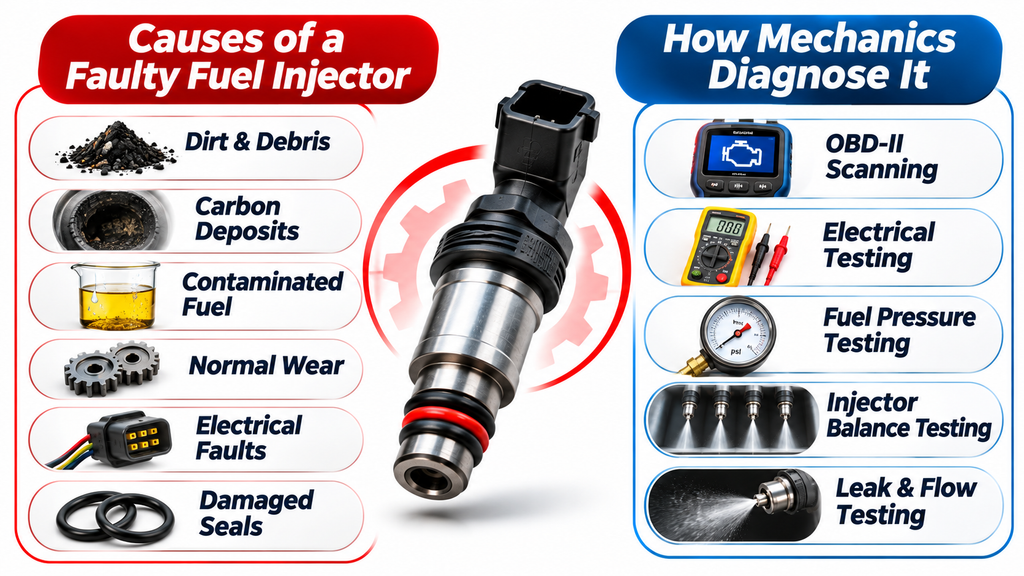
What Causes Fuel Injectors to Become Faulty?
The performance of injectors can degrade with time due to a number of factors.
- Dirt and debris: Contaminants can be captured in the fuel system and can narrow down the small fuel system injector passages.
- Carbon deposits: Deposits can disrupt fuel delivery and the spray pattern of fuel injectors.
- Water, and other contaminants will corrode and damage fuel systems when the fuel is contaminated, especially in sensitive fuel systems of diesel units.
- Normal wear: The parts of the internal injector wear out with repeated using.
- Electrical faults: Damaged wiring or connectors, or worn out injector solenoids, can prevent normal operation.
- Worn or cracked seals: Fuel and/or air may leak from damaged seals, depending on the design of the injector.
How Do Mechanics Diagnose a Faulty Fuel Injector?
With several other issues being able to mimic the symptoms of an injector failure can be a costly mistake.
These methods are diagnostic and may be used, if the person is a qualified mechanic:
- OBD-II scanning: Checks stored fault codes and engine operating information.
- Tests the wiring scheme for the injectors, connectors and electrical function.
- Fuel pressure testing: Tests to see if the fuel system has the pressure to maintain it.
- Injector balance testing: Compares amount of fuel injected, if applicable.
- Checks injector sealing, fuel delivery/ spray – leaker and flow test – suitable equipment.
Clogged vs Faulty Fuel Injector: What’s the Difference?
Fuel injector problems can come in many types, but one common one is a fuel injector that is clogged.
| Clogged injector | Faulty injector |
|---|---|
| Fuel passages are restricted by deposits or contamination. | May have mechanical, electrical or sealing damage. |
| Often causes reduced or uneven fuel delivery. | May deliver too little fuel, too much fuel or no fuel. |
| May cause hesitation and misfires. | May cause misfires, leaks and starting problems. |
| Professional cleaning may help. | Repair or replacement may be necessary. |
Read more: Does Fuel Injector Cleaner Improve Fuel Economy
FAQs About Fuel Injector Problems Symptoms
1. What are the most common bad fuel injector symptoms?
The signs are rough idling, engine misfire, reduced gas mileage, poor acceleration, misfires starting the engine, smelly gas, exhaust smoke, and the check engine light will be on.
2. How do I know if my fuel injector is clogged or faulty?
If this is the case, the injector could be clogged or a leak may have occurred, which will lead to shaking, uneven acceleration, misfires and failure to start. A diagnostic scan and/or flow or balance test with a diagnostic injector may help confirm the problem.
3. Can a bad fuel injector cause a car to shake?
Yes. A ‘leaky’ injector can cause irregular fuel delivery, which results in uneven combustion, engine vibration, particularly as the idle speed increases.
4. Does a bad fuel injector increase fuel consumption?
Yes. This could cause fuel loss if there is a leak or if the injector is overfuelling, which would lead to a loss of mileage. A clogged injector can, however cause other performance issues though, not necessarily higher fuel consumption.
Final Thoughts
It is simple to detect fuel injector problems signs if they’re detected early, which can prevent any engine problems, fuel waste and expensive repairs. If your car drags the clutch or has misfiring engines, poor acceleration or fuel leaks, have the fuel system checked out by a competent service shop. These are just a handful of symptoms that could be caused by something else, it is important to have them diagnosed before replacing an injector. Do not ignore the issue and ensure your engine is smooth, efficient and trouble-free.