Why Your Car’s Fuel Economy Has Dropped: 9 Causes to Check
Does your car seem to be consuming more petrol than what is expected at the rate of petrol consumption? Excessive wear, using the air conditioning constantly, wearing out tyres, and an engine issue all three can lead to a sudden drop in fuel economy. Other factors that may lead to higher fuel consumption in the UAE include extreme temperatures, dusty roads, and the nature of traffic.
This guide outlines 9 of the large list of reasons for low petrol consumption, warning symptoms and what you can do to save money on petrol before a little problem turns into a big one.
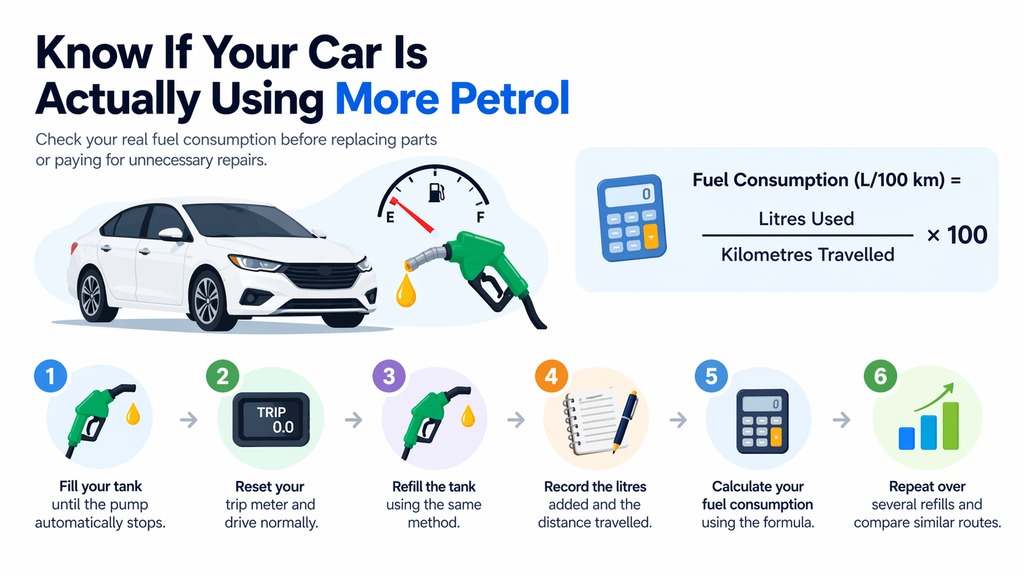
Know If Your Car Is Actually Using More Petrol
Prior to parts replacement or a remedy visit, it is important to ensure that your vehicle is actually guzzling extra gasoline.
Sometimes, vehicle drivers get the impression that they are paying more for petrol than they actually are: either because petrol prices have risen or because they have changed their patterns of driving. This does not always indicate that the car has become less efficient with regard to fuel usage.
The best way to check is to calculate your vehicle’s actual fuel economy.
Calculate Your Car’s Fuel Consumption
Fuel consumption is measured in litres per 100 kilometres (L/100 km), which is a helpful unit for UAE drivers.
Fuel consumption formula:
Fuel consumption (L/100 km) = (Litres used ÷ Kilometres travelled) × 100
Visit: UAE Fuel Cost Calculator
Check Fuel Consumption Accurately
- Fill your tank until the pump automatically stops.
- Reset your trip meter and drive normally.
- Refill the tank using the same method.
- Record the litres added and the distance travelled.
- Calculate your fuel consumption using the formula above.
- Repeat over several refills and compare similar routes.
9 Reasons Your Car’s Fuel Economy Has Dropped
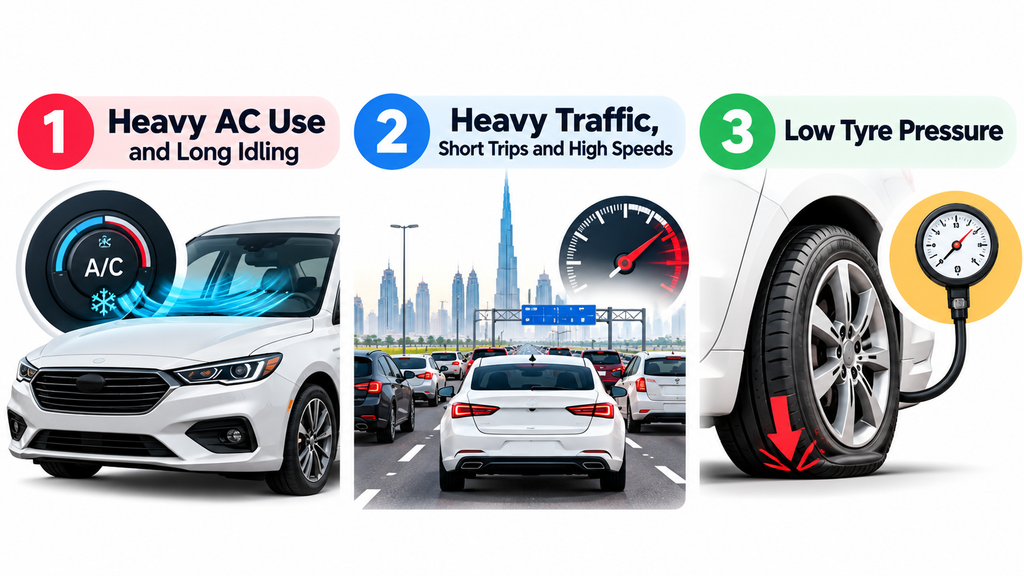
1. Heavy AC Use and Long Idling
Air conditioning is essential for comfortable driving in the UAE, particularly during hot summer months. However, running the AC increases the engine’s workload in most petrol cars because the compressor requires energy to operate.
When the outside temperature is extremely high, the AC system has to remove more heat from the cabin. This can increase fuel consumption, especially in slow traffic.
2. Heavy Traffic, Short Trips, and High Speeds
Factors such as your driving habits as well as the weather can make a big difference to fuel consumption.
In heavy traffic, successive changes of speed use up energy. Another possibility is that a short trip may not be as efficient since the engine may not get its normal operating temperature before the end of the drive.
On the highway, higher speeds likely increase aerodynamic drag, which requires more energy to maintain.
3. Low Tyre Pressure
Tyres that are underinflated can cause more rolling resistance, which requires a greater effort from your vehicle’s engine. This can lead to greater petrol consumption as well as poorer handling, braking and tyre wear characteristics.
The pressure in tyres can fluctuate due to air loss, temperature variations, or punctures. Just as tyres can be under-inflated and appear not to be flat, they can be under-inflated and appear to be inflated.
Warning signs include:
- A tyre-pressure warning light.
- Uneven tyre wear.
- A tyre that looks flatter than the others.
- Changes in steering or handling.
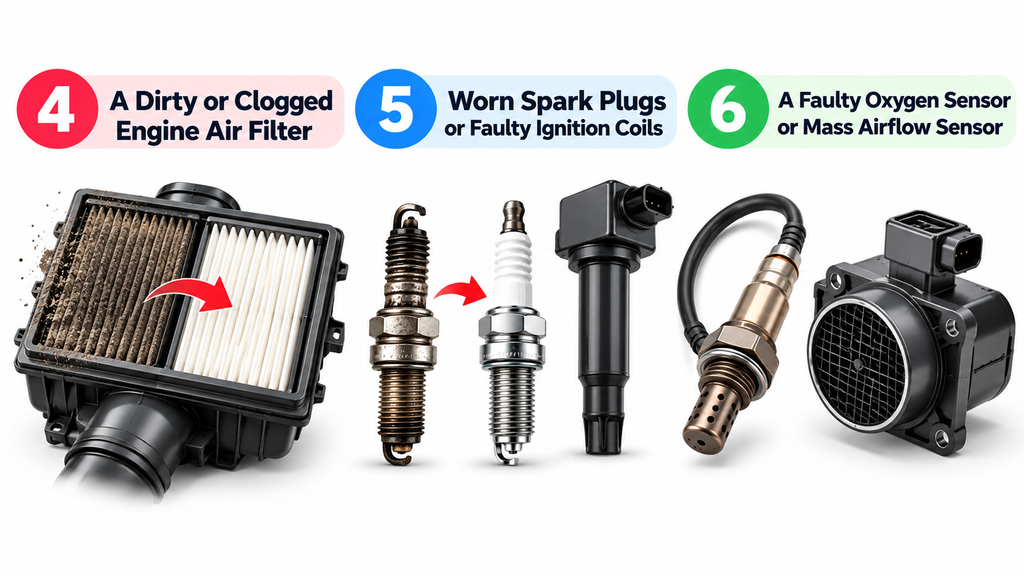
4. A Dirty or Clogged Engine Air Filter
It is important that the combination of air and fuel in your engine is right for efficient combustion. The engine air filter is designed so that it doesn’t let any dirt and sand into the engine; it’s just a matter of time before dust accumulates inside the filter.
Driving on dusty roads can make regular inspection especially important in the UAE. A severely restricted filter may affect engine performance, although a dirty filter does not automatically cause a large increase in fuel consumption in modern fuel-injected cars.
5. Worn Spark Plugs or Faulty Ignition Coils
In a petrol engine, the air-fuel mixture in the cylinder is set off by the spark plugs. A spark is formed by the electrical energy provided by ignition coils.
The combustion can be unstable if the spark plugs wear out, or if the ignition coil fails. This can cause misfiring engines, slower starts, there may be some rough running and increased fuel consumption.
6. A Faulty Oxygen Sensor or Mass Airflow Sensor
Modern petrol engines use sensors to aid engine fuel control.
In the exhaust gases, an oxygen sensor records the oxygen content, and the engine computer adjusts the air-fuel mixture accordingly. This computer will calculate the proper amount of fuel to inject if a mass airflow sensor is used on the air intake.
This is because the engine may run inefficiently if either sensor gives an incorrect reading. This can result in fuel consumption rising, performance limitations, or emissions increasing, depending on the fault.
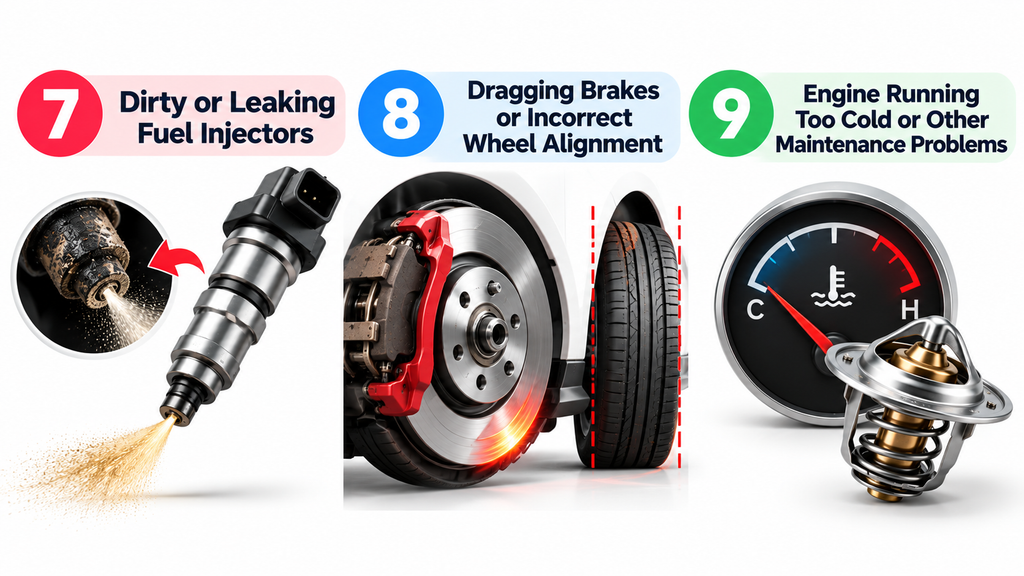
7. Dirty or Leaking Fuel Injectors
Fuel injectors are small components that pump petrol into an engine only as needed to power the vehicle. Deposits can affect their operation; fuel delivery can be less efficient.
Some of the common problems include poor running or starting, a lack of acceleration, or higher gas use. This type of fault could be more serious if the injector is leaking, as fuel can get into the engine when it shouldn’t.
8. Dragging Brakes or Incorrect Wheel Alignment
A free-moving vehicle will save your life. When a brake is partially applied, there will be more resistance in the way of the engine having to work to overcome.
If the brake caliper or brake pad is sticking or if the brake discs are worn, the brake shoe may rub even when the brake pedal is not depressed. Also, incorrect tyre position can lead to quicker tyre wear and extra resistance at the wheels when they are out of specification at a high level.
9. Engine Running Too Cold or Other Maintenance Problems
An Engine operates in a certain temperature range. If it fails to warm up internally or reach normal operating temperature in an unusual amount of time, it will mean that fuel economy may be poor.
A thermostat that is stuck open may be the culprit. This can cause excessive movement of the coolant during warm-up and may prevent the engine from operating at the correct temperature.
Common Symptoms of High Fuel Consumption and What They Mean
Think about the causes in the subscript boxes and what to look for in the next subscript boxes. The symptoms are not the diagnosis – they are clues.
| Symptom | Possible cause | What to do |
|---|---|---|
| Higher fuel consumption in hot weather | Increased AC use or idling | Compare similar trips and reduce unnecessary idling |
| Rough idling or poor acceleration | Ignition, sensor, injector, or airflow problem | Arrange an engine inspection |
| Check engine light | Engine-management or emissions fault | Obtain a diagnostic scan |
| Tyre-pressure warning | Underinflated or damaged tyre | Check pressure and inspect the tyre |
| Car pulls to one side | Tyre, alignment, brake, or suspension issue | Have the vehicle inspected |
| Burning smell or unusually hot wheel | Possible dragging brake | Stop safely and seek assistance |
| Petrol smell or visible leakage | Possible fuel-system leak | Switch off the engine and arrange urgent assistance |
| Engine takes too long to warm up | Possible thermostat or temperature-control fault | Have the cooling system checked |
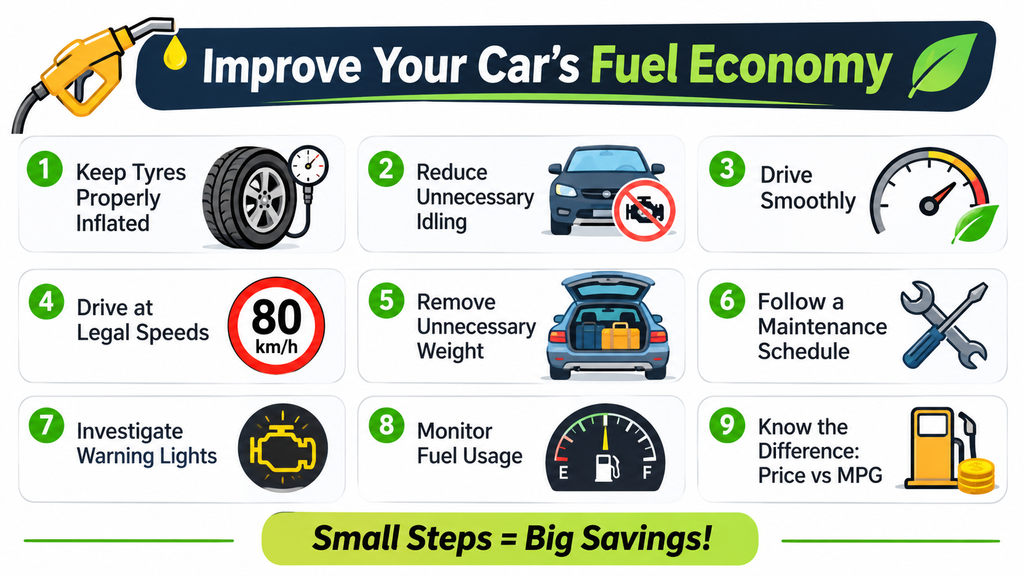
Improve Your Car’s Fuel Economy
If you are sure that your fuel consumption has gone up, here are a few useful tips to help you cut down on needless petrol consumption.
- Keep tyres properly inflated. Regularly inspect tyres for problems and look into pressure loss that happens often.
- Reduce unnecessary idling. Turn off the engine when stopped for extended periods, when safe and appropriate.
- Drive smoothly. Don’t accelerate or brake unnecessarily.
- Safety First! Drive at legal speeds. The faster a vehicle goes, the more fuel it will consume.
- Remove unnecessary weight. This produces higher consumption if it has too much weight or heavy accessories that are not being used on the roof.
- Use a maintenance schedule. Change ignition filters, spark plugs, and car oil as needed.
- Investigate warning lights. Don’t dismiss signs of continued warnings, rough running, or sudden loss of performance.
- Monitor the use of fuel. Take a comparison of a multi-burner compared to a few with similar driving conditions.
- Memorize the difference between gas prices and miles per gallon. If the price is higher per litre, but your car uses the same amount of petrol, you’re going to have to pay more.
For more practical advice, read our guide to reducing fuel consumption in the UAE: How to Reduce Fuel Consumption in the UAE.
FAQs: Why Is My Car Using More Petrol?
Does a bad Oxygen Sensor increase Fuel Economy?
Yes. This is because a problem with the oxygen sensor can cause an incorrect air-fuel mix and lead to higher petrol consumption. A diagnostic scan will help determine the issue once it is confirmed.
Does Car AC Increase Fuel Consumption in the UAE?
Yes. AC increases engine load, especially during UAE summers, heavy traffic, and long periods of idling.
Can Low Tyre Pressure Make a Car Use More Petrol?
Yes. During the summer in the UAE, heavy traffic and idling hours, engine load will increase with the use of AC.
Final Thoughts
If it seems the car is using more petrol than normal, don’t put it down. Failing to maintain tyres properly, running under conditions of high air conditioning pressure, low tyre pressure, or congested traffic can lead to loss of fuel efficiency; worn spark plugs, or issues with the fuel system could indicate a need for professional repair.
Looking for more efficient methods to control your car costs? Explore with accuracy the cost of fuel in the UAE using our fuel cost calculator, so you can budget your trip and of course, your fuel costs. Regular servicing items and good driving techniques will enable you to identify issues at an early stage, reduce the amount of petrol you use and prevent unnecessary expenses.


