Does Low Tyre Pressure Increase Fuel Consumption?
Does low tyre pressure make tyres leak gas and cost you petrol? Yes, substandard tyres have higher rolling resistance, which requires more engine power and may consume more fuel to travel a given distance. It’s an unnecessary petrol cost, quicker tyre deterioration, and safety issues, particularly on hot days and extended highway trips for drivers in the UAE. Thankfully, there are ways to determine the proper tyre pressure and keep them in good condition.
In this guide, you will learn the impact of low tyres and their fuel economy, to estimate the additional petrol cost in AED, the correct method of checking tyre pressure, and how to make sure your tyres are properly inflated to drive efficiently and safely in the UAE.
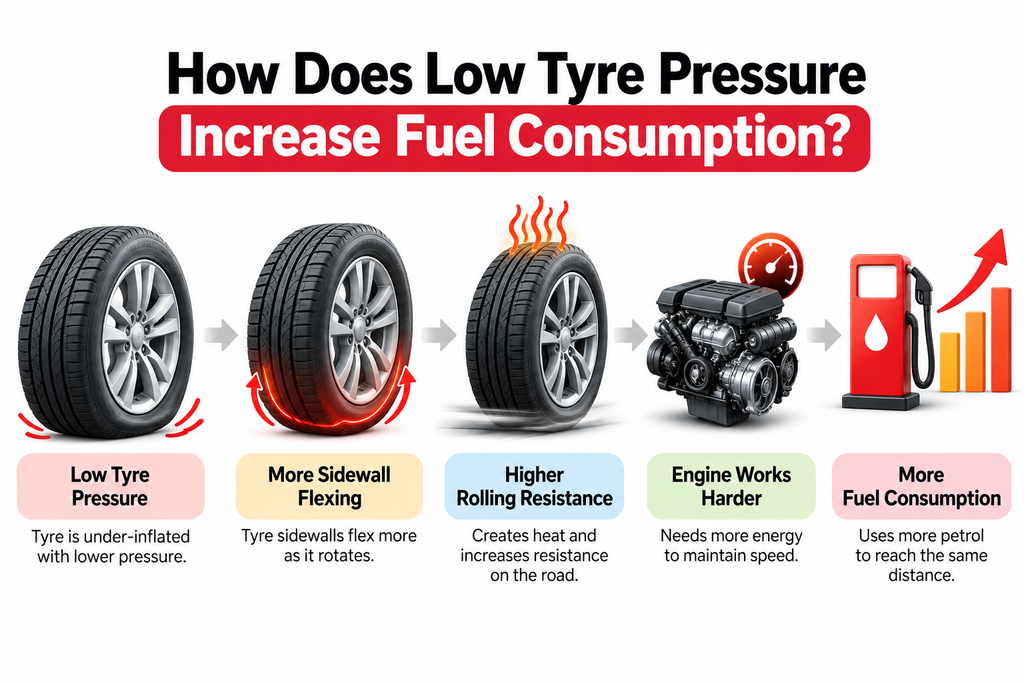
How Does Low Tyre Pressure Increase Fuel Consumption?
This is because the tyre is under-inflated, meaning it has lower tyre pressure, which will lead to an increase in rolling resistance—the resistance a tyre offers while rolling across the surface of the road.
Being underinflated causes the tyre’s sidewalls to flex more than usual as the tyre rotates. This causes a heat loss and reduces the efficiency of the journey as the engine has to struggle to keep the speed; as it is working harder, it ends up burning more fuel to reach the same goal. This makes driving the same distance using the same car end up using a lot more petrol.
With the right inflation, as much as 3% and on average 0.6% fuel savings can be realised on tyres. These amounts are approximate values only and cannot guarantee vehicle-specific savings.
How Much Extra Petrol Can Low Tyre Pressure Cost?
The more fuel you lose from your tyres due to under-inflation, and the more miles you drive (or the less miles you make with the tires), the more fuel you’re going to end up spending each year.
Consider this illustrative example:
| Measurement | Example |
|---|---|
| Annual distance | 20,000 km |
| Fuel economy | 10 km/L |
| Annual fuel use | 2,000 litres |
| Example petrol price | AED 4.28/L |
| Annual petrol cost | AED 8,560 |
Suppose fuel economy were 1% lower because of underinflation. Covering the same distance would require approximately 2,020 litres—20 extra litres costing AED 85.60 per year at AED 4.28 per litre.
Use these formulas to estimate your costs:
- Fuel required (litres) = Distance (km) ÷ Fuel economy (km/L)
- Petrol cost (AED) = Fuel required × Price per litre
For your next journey, try our UAE fuel cost calculator.
What Is the Correct Tyre Pressure for Cars in the UAE?
It’s important to note that no single tyre pressure is the optimum setting for every vehicle. It is dependent upon the manufacturer’s specification, the tyre size, the load of the vehicle, and sometimes the front and rear axles.
Check your owner’s manual or the driver’s door frame label for the recommended cold tire pressure. Some cars even print this information on other parts of the car, like the fuel-filler flap.
Never take the maximum pressure on the tyre sidewall as a working maximum pressure. Instead, adhere to the manufacturer’s advice.
Does UAE Hot Weather Affect Tyre Pressure?
Yes. A tyre’s pressure tends to increase with rising temperature of the tyre under driving conditions. This change is particularly relevant in the UAE, where the warm conditions of hot weather and road surfaces increase the danger.
Do this before going for any drive or after three hours or more on standby.
Do not let air out, irrespective of whether there is a pressure reading at the high end of the hot tyre reading as suggested by the manufacturer. This can result in an under-inflated tyre when it cools. If you have to check pressure when travelling, do as your car company recommends and always re-check when your tyres are cold.

How to Check Tyre Pressure Correctly
Please follow the steps below:
- Always check cold tyres: check pressure before operation or after parking for 3+ hours.
- Use the driver’s door label or owner’s manual to determine the recommended PSI.
- Test all tyres: Use a meter, not a visual inspection.
- Inflate if necessary: Fill each tyre with air to the cold pressure which is stated in the specification.
- Check again: Recheck to make sure the reading is correct; replace valve caps.
- Investigate repeated pressure loss: A puncture, leaking valve, or damaged rim may require professional attention.
The National Highway Traffic Safety Administration (NHTSA) recommends checking all tyres, including the spare where applicable, at least monthly and before long trips.
How Often Should You Check Tyre Pressure in the UAE?
A useful technique that can be used is to have a regular check up of tyre pressure (particularly before long journeys) and make this part of monthly maintenance.
The NHTSA recommends that owners do monthly tests since tires can lose pressure over time and may lose pressure when they are mounted on a rough surface or curbs.

Can Overinflated Tyres Also Affect Fuel Economy?
Yes. Underinflation increases rolling resistance, but overinflating tyres beyond the manufacturer’s recommendation is not a safe shortcut to better fuel economy.
| Tyre condition | Potential effect |
|---|---|
| Underinflated | More rolling resistance, excess heat, uneven wear and possible tyre failure |
| Correctly inflated | Intended handling, more consistent wear and better fuel-efficiency potential |
| Overinflated | Harsher ride, uneven wear, and greater vulnerability to some road impacts |
What Else Can Increase Fuel Consumption?
Tyre pressure is just one of the factors that impact fuel economy. Other causes include:
- Stride regularly: If you accelerate and brake several times a mile, you consume more gas.
- Engine load: Air conditioning increases load on the engine (depending on the conditions)
- Aerodynamic drag: Resistance of the air to the object’s motion increases as the object moves at higher speeds.
- Extra weight/Redundant personal load: When the person is carrying unneeded equipment and materials.
- Maintenance issues: If wheels are not aligned properly, if brakes are dragging, or if there are issues with the engine, this can decrease efficiency.
- Repeated short trips: Short trips and repeated cold starts could result in higher fuel consumption per kilometre.

If your fuel consumption rises unexpectedly, check tyre pressure and consider whether the vehicle needs professional inspection. Explore our fuel-saving guides for UAE drivers.
Frequently Asked Questions
1. Does low tyre pressure increase fuel consumption?
Yes. An under-inflated tyre has higher rolling resistance, which makes the engine more heavily loaded and possibly even contributes to higher fuel consumption.
2. How much fuel can underinflated tyres waste?
This may vary depending on the pressure drop, vehicle, and driving conditions. Correctly inflating tyres will increase fuel efficiency, although the efficiency gains differ for each vehicle type.
3. What are the proper tyre pressures for driving in the UAE?
Look at the tyre-pressure label on your driver’s door frame or in the owner’s handbook. Specific recommendations for pressure for a given vehicle and load.
4. What is the optimal tyre pressure for Dubai?
Inspect tyres before long journeys and at least once a month. If a warning light is turned on or suspected to be leaking, inspect earlier.
5. Should I reduce tyre pressure when tyres get hot?
The pressure of tyres always increases while driving. Always check tyres when they are cool and be warned of air release due to hot tyre readings.
Final Thoughts
Low tyre pressure can result in higher fuel consumption and cause tyres to wear out more rapidly, and can impact driving safety as well. UAE drivers can help keep their cars running efficiently and avoid potential issues by checking their tyre pressure once a month at the recommended PSI range and before embarking on longer trips. Want to keep your petrol costs under control? Check your tyres regularly and use our UAE fuel cost calculator to estimate your journey expenses and plan your fuel budget more effectively.